
Introduction
Commercial properties rarely fail because no cameras exist. More often, risk grows in the areas that cameras do not fully see. A warehouse may have clear coverage at the main entrance but weak visibility around trailer parking. A construction site may have cameras near the gate but limited coverage as materials, fencing, and equipment move throughout the project. An industrial yard may record activity near the office while remote perimeter zones remain exposed. These gaps are surveillance blind spots, and they can create serious security weakness.
Blind spots matter because commercial incidents often begin away from obvious activity zones. Trespassers may test a fence line, thieves may target stored materials, vandals may approach from a service road, and unauthorized vehicles may enter through less visible access points. If a security system cannot observe these areas in real time, the property may not discover the problem until after loss or damage has already occurred. Eliminating blind spots requires more than installing more fixed cameras. It requires a coordinated strategy that combines camera placement, monitoring, response planning, and mobile visibility.
Why Fixed Cameras Cannot Cover Everything
Fixed cameras are essential for commercial security, but they are limited by their position. A mounted camera sees what its angle, height, lighting, and field of view allow it to see. Buildings, trucks, containers, fencing, machinery, trees, parked vehicles, signage, and temporary structures can all block the view. Even high-quality cameras can miss important movement when the property layout is complex or constantly changing.
This is especially true for facilities with large outdoor spaces. Warehouses, logistics centers, construction projects, manufacturing sites, storage yards, and commercial campuses may stretch far beyond the reach of a few fixed camera points. Adding cameras can help, but it does not always solve the entire problem. Some areas are difficult to wire, difficult to power, difficult to mount, or too temporary for permanent camera installation. In those cases, property owners need flexible visibility that can move with the risk.
How Can Businesses Extend Surveillance Beyond Fixed Camera Locations?
Fixed surveillance cameras play a critical role in commercial security, but every camera system faces physical limitations. Buildings obstruct sight lines, large perimeters create coverage challenges, and changing environments can leave portions of a property outside the field of view. Warehouses, industrial facilities, construction sites, and logistics centers often contain areas that remain difficult to observe consistently through stationary equipment alone. Expanding visibility requires a solution that can move beyond fixed surveillance positions.
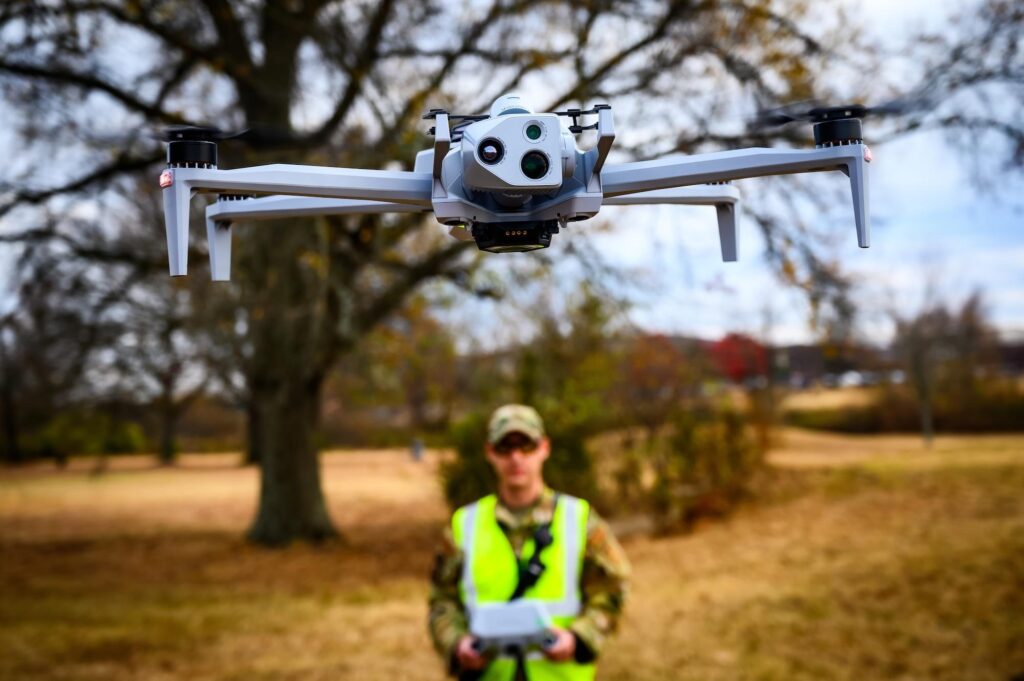
Many organizations address this challenge through drone surveillance integration. By connecting aerial monitoring capabilities with existing security operations, businesses gain access to mobile observation that can cover large areas, inspect remote sections of a property, and provide visibility where traditional camera placement is impractical. Aerial surveillance complements existing security infrastructure rather than replacing it, creating broader coverage across complex environments.
The combination of drones, camera networks, and monitoring personnel improves situational awareness across locations that experience frequent activity changes or extensive perimeter exposure. Security teams can evaluate developing situations from multiple perspectives, observe areas that are difficult to access quickly from the ground, and maintain greater awareness of conditions across the property. Enhanced visibility supports earlier threat detection, more informed decision-making, and stronger overall security coverage. As commercial facilities continue to expand and operational environments become more dynamic, organizations increasingly adopt integrated surveillance strategies that combine fixed and mobile monitoring resources into a coordinated security framework.
The Real Cost of Blind Spots
A surveillance blind spot can appear small on a property map, but its consequences can be large. A poorly covered storage area can invite theft. A hidden fence line can become a repeated trespassing route. A dark corner of a parking lot can create safety concerns. A loading dock without proper oversight can become vulnerable during off-hours. Once offenders identify an area where they are unlikely to be seen, that location can become the soft underbelly of the property.
The cost is not limited to stolen assets. Businesses may face downtime, repairs, insurance claims, tenant complaints, employee safety concerns, customer distrust, and reputational damage. In some cases, poor visibility can also delay emergency response. If a person enters a restricted or hazardous area and no one sees it quickly, the issue can move from a security concern into a safety incident. Stronger surveillance coverage helps reduce these delays by making risk visible earlier.
Changing Layouts Create Changing Risks
Commercial blind spots are not always permanent. They may appear after the original camera system has already been installed. A warehouse might add new racks, trailers, containers, or outdoor storage. A construction site might move fencing, shift materials, or open a new access route. A logistics center might change traffic patterns. A commercial campus might expand parking or add temporary work zones. Each change can affect what the cameras can see.
That is why blind spot management should be an ongoing process rather than a one-time installation decision. Security teams need to review camera coverage, lighting, access points, equipment placement, and perimeter exposure as property conditions change. The same thinking applies to digital and network security, where testing and visibility are used to reveal hidden weaknesses. A discussion of Wi-Fi network security testing efficiency reflects a similar principle: systems are stronger when hidden vulnerabilities are identified before they are exploited.
Why Live Monitoring Matters
Visibility becomes more valuable when someone can act on it. A camera may capture suspicious movement, but if the footage is only reviewed after an incident, the property still loses the chance to intervene early. Live monitoring changes that by placing trained operators behind the surveillance system. Operators can observe activity as it develops, verify whether behavior appears suspicious, and follow response procedures when necessary.
This matters because many commercial incidents show warning signs before they escalate. A vehicle may circle the property. A person may approach a restricted area after hours. Someone may linger near equipment, test a gate, or move along a fence line. When these signs are seen in real time, security teams can respond sooner. That response may involve an audio warning, contacting site management, dispatching a guard, or escalating the issue to law enforcement depending on the situation.
Mobile Visibility Supports Better Decisions
Aerial surveillance gives commercial security teams another perspective. Fixed cameras may show one angle of a loading dock or gate, while drone-supported observation can help assess the surrounding area. This can be especially helpful when a property has wide perimeters, open yards, remote access roads, or changing activity zones. Aerial visibility can show movement patterns that ground-based cameras may miss.
Mobile visibility also supports better decision-making. If operators can see where a person came from, where they are moving, and whether other people or vehicles are involved, they can assess the situation more clearly. This is valuable for large properties where one camera angle may not provide enough context. The goal is not only to see more, but to understand more. Better context leads to better response.
Security Is Moving Toward Integrated Systems
Modern commercial security is no longer built around one tool. Cameras, access control, mobile monitoring, remote guarding, lighting, alarms, communication systems, and response protocols all work better when connected. A camera without monitoring may record evidence. A drone without coordination may provide a view. A guard without real-time information may patrol blindly. Integration turns these separate pieces into a functional security framework.
This wider movement can be seen across many property types, including residential communities where mobile tools are being used to improve access and gate security. Coverage of mobile-based security gate solutions for apartments shows how property protection is increasingly shaped by connected systems, faster communication, and smarter access management. Commercial properties face different risks, but the same direction is clear: security becomes stronger when visibility, control, and response work together.
Brand Section: Pioneer Security’s Integrated Surveillance Approach
Pioneer Security supports commercial properties that need broader visibility than fixed cameras can provide alone. Its approach combines live video monitoring, remote guarding practices, video verification, and drone-supported observation to help businesses reduce blind spots across complex environments. This is especially relevant for warehouses, industrial sites, logistics yards, construction projects, commercial campuses, and properties with large outdoor assets.
The value of this approach is coordination. Fixed cameras provide continuous views of important locations, monitoring operators interpret activity in real time, and drone integration extends awareness into areas that may be difficult to cover from the ground. Instead of treating surveillance as a passive recording system, the model turns visibility into an active security resource. For properties where risk can shift with layout, operations, and daily activity, that flexibility is a practical advantage.
Conclusion
Commercial properties eliminate surveillance blind spots by moving beyond camera placement alone. Fixed cameras remain important, but they cannot cover every angle, every remote section, or every changing condition across a complex property. Blind spots create opportunity for trespassing, theft, vandalism, unauthorized access, and delayed response, especially when no one is actively monitoring the system.
A stronger strategy combines fixed surveillance, live monitoring, mobile visibility, aerial observation, and clear response procedures. When these elements work together, businesses gain a security framework that sees more, understands more, and responds faster. The goal is not simply to record what happened. The goal is to reduce the spaces where risk can hide.


